A month of transits on a Davison relationship chart
A Davison chart is cast for the midpoint in time between two births and the midpoint in space between the two birthplaces. It is the chart of a moment that really happened, over a place that really exists, with real houses and angles, and astrologers read it as the chart of the relationship itself. The planets moving overhead make aspects to it as they do to a birth chart.
Cast the chart
The month on your Davison chart
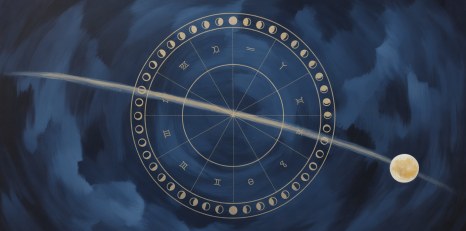
A day of transits is a snapshot. The contacts that matter most come from the slow planets, and they apply, perfect and separate over weeks or months, so a single day can only say that one is in orb. A month shows the arc: when each contact begins, the day it is exact, when it lets go, and whether it comes back after a station.
Read the slow contacts first. A Saturn, Uranus, Neptune or Pluto contact to the Davison chart is a season the relationship is living through, and the month sits inside it. The faster planets, the Sun, Mercury, Venus and Mars, give the dated moments: a few days each, a mood against that backdrop. The Moon is left out, because in a month she touches every point of the chart.
Houses are where a Davison earns its keep over a composite. A planet walking through the seventh or the fifth house of the relationship chart is about the relationship's own areas of life, and a planet changing house mid-month changes what the month is about. With both birth times known the report shows the day of each change.
This is not the monthly relationship forecast, which transits the composite: an average of the two charts, with equal houses from a midpoint Ascendant. The two charts also disagree about where the planets are, so the two months are two readings, and a couple who use both are reading two different questions.
Questions people ask
What does the month on a Davison chart show?
Every aspect the planets make to the relationship chart during the month, with the day each one begins, the day it is exact and the day it fades; the stations of planets turning retrograde or direct; and the houses of the Davison chart the planets walk through.
Why is the Moon not included?
In a month the Moon makes a hard aspect to every point of the chart, often twice. At this scale those contacts would drown the ones that last. The day report on the same chart keeps her, because for a day she matters.
Do we both need a known birth time?
For the aspects to the chart's planets, no. For the houses and the angles, yes, and those are the reason to follow a Davison rather than a composite. An error in either birth time moves the midpoint by half of it, which is still enough to move the Ascendant by a few degrees.
Nothing slow touches our chart this month. Is something wrong?
No. The tight orbs mean a slow planet only counts while it is within a degree and a half, so some months are carried by the faster planets alone. The houses the slow planets are walking still set the backdrop.
Follow us on social media for the daily astrological mood and occasional free PDF coupon codes for personalized readings.