Eclipse calculator: your prenatal Moon and the eclipses ahead
Two things here, and the first is fixed for life. Before you were born there was a New or Full Moon — the prenatal lunation — and the degree it fell on is treated as a sensitive point in your chart for as long as you live. Planets and eclipses that come back to it tend to coincide with the periods a person afterwards describes as turning points.
Cast the chart
Eclipses
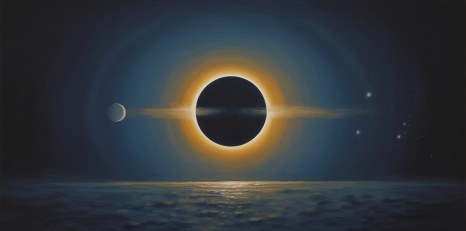
The second is the calendar ahead. Eclipses arrive in pairs and seasons, roughly every six months, and the popular version of astrology treats each one as an event for everybody. It is not. An eclipse is a New or Full Moon with the Moon's nodes nearby, and it becomes personal only where it falls: on your own planets and angles, or on nothing much of yours at all.
So the useful question is not what this eclipse means, but whether it touches you. An eclipse within a degree or two of a natal planet is worth attention; one fifteen degrees away from anything is weather happening to other people. The report lists what is coming and marks the ones that land on your chart, which is the whole of the technique.
What an eclipse does where it lands is bring something to a head rather than begin it. Solar eclipses are read as openings and lunar ones as culminations and endings, and both tend to date something that had already been building. Read them alongside the slower techniques — a progression or a return running at the same time is what gives an eclipse something to work on.
The prenatal lunation needs only your birth date; the degrees of the eclipses ahead need nothing of yours at all. A birth time matters for deciding which house an eclipse falls in, and that is often what decides whether it is felt at work, at home or in a relationship.
Questions people ask
What is a prenatal eclipse or prenatal lunation?
The New or Full Moon immediately before your birth. The degree it fell on stays sensitive for life, and returns to it are read as marking turning points.
Does every eclipse affect me?
No, and this is the most common misunderstanding about eclipses. One matters where it falls: close to your own planets or angles it is personal, and fifteen degrees away from anything of yours it is not.
What is the difference between a solar and a lunar eclipse in a chart?
A solar eclipse is a New Moon and reads as an opening; a lunar eclipse is a Full Moon and reads as a culmination or an ending. Both usually date something already in motion rather than starting it from nothing.
Do I need my birth time?
Not for the prenatal lunation or for the eclipse dates. You need one to say which house an eclipse falls in, which is often what decides the area of life it touches.
Follow us on social media for the daily astrological mood and occasional free PDF coupon codes for personalized readings.