Birth chart aspects calculator
An aspect is the angle between two planets, and it is where a chart stops being a list and starts being a description. Planets in aspect are in conversation: they act together, get in each other's way, or lend each other something. Planets with no aspect between them tend to operate as if the other were not there, which is its own kind of information.
Cast the chart
Aspects, Combos, Houses
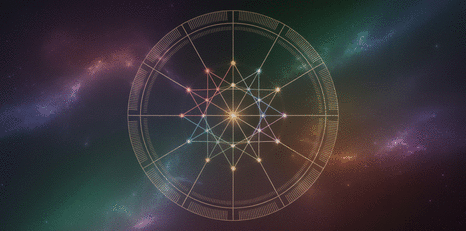
Five angles do most of the work. A conjunction, zero degrees, fuses two planets so you cannot easily tell them apart. An opposition, a hundred and eighty, puts them face to face and usually plays out through other people. A square, ninety, is friction between things that will not be reconciled by wanting them to be. A trine, a hundred and twenty, is ease. A sextile, sixty, is ease that needs a nudge.
The hard ones are not the bad ones. A square describes something that keeps demanding work, and work is what produces anything worth having — most people's real competence sits on a square. A trine describes something that comes so easily it is often wasted. Read the hard aspects for where the life happens and the soft ones for what is available if you bother to use it.
How close the angle is to exact decides how loudly it speaks. Within a degree or two it is unmistakable and shows up in a first conversation; at seven or eight degrees it is background colour. The report lists the closest first, which is the right reading order and not the order most software uses.
Aspects also combine into shapes, and a shape says more than its parts. Two planets squaring a third that opposes one of them is a T-square, which behaves like a problem that will not stay solved. Three planets in trine make a grand trine, which is self-sufficient enough to become a rut. Several planets together in one sign or house make a stellium, and that part of the chart dominates whatever else is going on.
Finally, the same aspect reads differently depending on where it falls. Mars square Saturn between the third and sixth houses is an argument about work and routine; the same square between the seventh and tenth is one about partnership and standing. The signs and houses are in this report for that reason — an aspect read without them is a horoscope, not a chart.
Questions people ask
What is an aspect in astrology?
The angle between two planets in your birth chart. The five that matter most are the conjunction, sextile, square, trine and opposition, and they describe how two parts of a chart deal with one another.
Are squares and oppositions bad?
No. They describe friction, and friction is where the work — and usually the competence — is. The easy aspects describe what comes cheaply, which is exactly why it often goes unused.
What is an orb?
How far the angle is from exact. Within a degree or two an aspect is unmistakable; at seven or eight degrees it is background. This report puts the closest first.
Do I need my birth time for aspects?
Not for aspects between planets — those are nearly the same all day, except for the Moon. You need one for aspects to the Ascendant and Midheaven, and for the houses the report reads them in.
Follow us on social media for the daily astrological mood and occasional free PDF coupon codes for personalized readings.